


Level Up Your Credit
Level Up Your Credit
2026
2026
Self-directed E-learning course
Tools: Articulate Rise, Claude Code
Role: Learning & Multimedia Designer
Self-directed E-learning course
Tools: Articulate Rise, Claude Code
Role: Learning & Multimedia Designer
INSTRUCTIONAL DESIGN
INSTRUCTIONAL DESIGN
MULTIMEDIA DESIGN
MULTIMEDIA DESIGN

Analyze
Analyze
To address a critical gap in traditional student financial literacy resources, which frequently rely on dry text and dense calculations. This independent module reimagines introductory credit education for a digital-native Gen-Z audience.
The Constraints
Time-to-Completion: Content must deliver maximum behavioral retention within a tight 10–15 minute micro-learning window.
Compliance Baseline: The information architecture must align directly with the Financial Consumer Agency of Canada (FCAC) consumer disclosure framework.
Inclusivity: Interaction layers must satisfy strict enterprise WCAG 2.1 AA accessibility laws for keyboard navigation and low-vision clarity.
To address a critical gap in traditional student financial literacy resources, which frequently rely on dry text and dense calculations. This independent module reimagines introductory credit education for a digital-native Gen-Z audience.
The Constraints
Time-to-Completion: Content must deliver maximum behavioral retention within a tight 10–15 minute micro-learning window.
Compliance Baseline: The information architecture must align directly with the Financial Consumer Agency of Canada (FCAC) consumer disclosure framework.
Inclusivity: Interaction layers must satisfy strict enterprise WCAG 2.1 AA accessibility laws for keyboard navigation and low-vision clarity.
Design
Design
The course architecture uses key instructional design principles and Articulate Rise's custom layout system to create an engaging and high-retention course.
The course architecture uses key instructional design principles and Articulate Rise's custom layout system to create an engaging and high-retention course.

Each module begins with an eye-catching hero illustration and accompanying copy, deliberately designed as an attention-grabbing device (Gagné's first event).
Each module begins with an eye-catching hero illustration and accompanying copy, deliberately designed as an attention-grabbing device (Gagné's first event).
Each module begins with an eye-catching hero illustration and accompanying copy, deliberately designed as an attention-grabbing device (Gagné's first event).
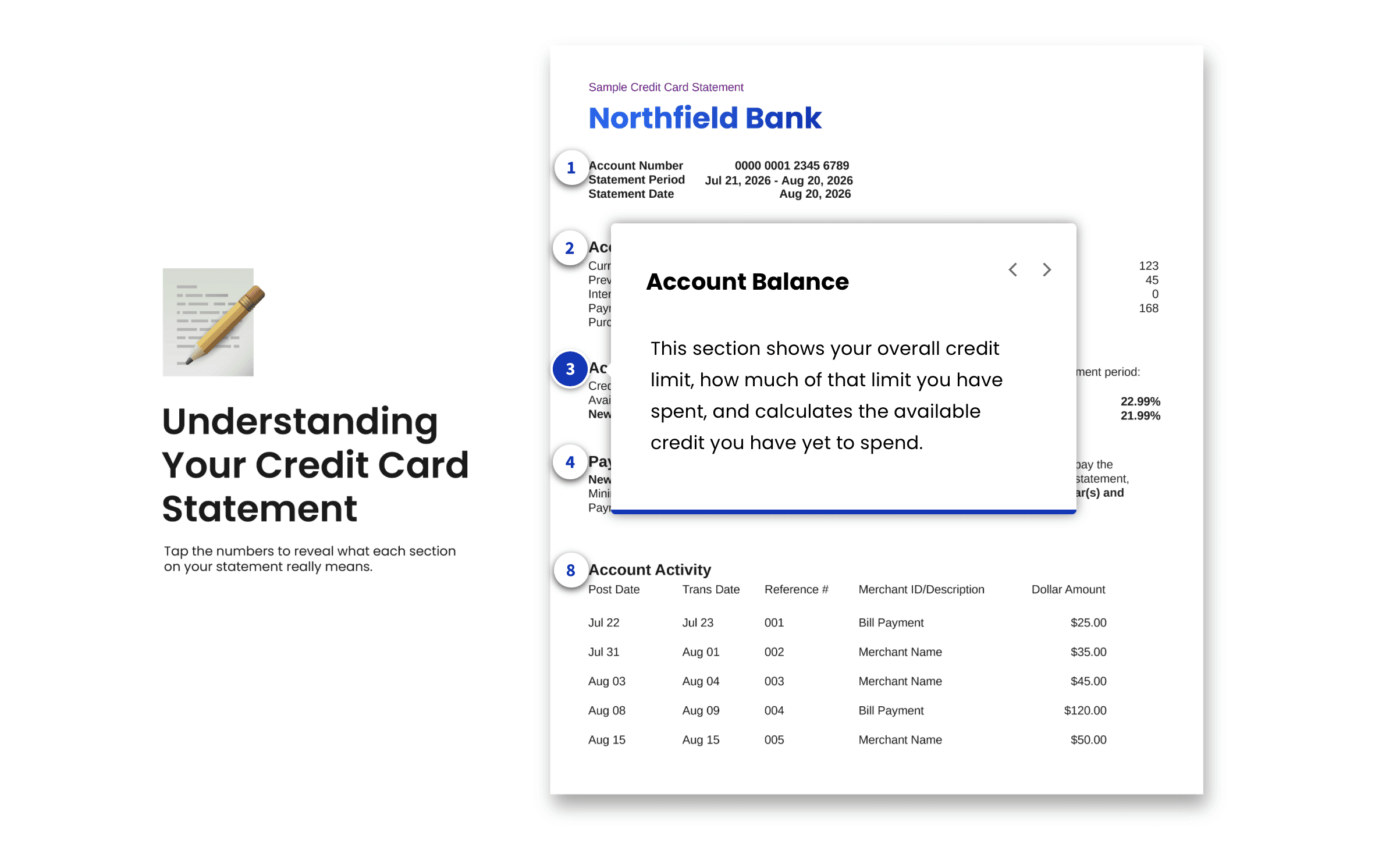
Heavy text sections are broken into interactive, click-to-reveal hotspot components, giving users full control over their learning pace. The visual uses a sample real-world statement to help learners contextualise new knowledge.
Heavy text sections are broken into interactive, click-to-reveal hotspot components, giving users full control over their learning pace. The visual uses a sample real-world statement to help learners contextualise new knowledge.
Heavy text sections are broken into interactive, click-to-reveal hotspot components, giving users full control over their learning pace. The visual uses a sample real-world statement to help learners contextualise new knowledge.
Develop
Develop
The course was built primarily in Articulate Rise 360, chosen for its speed across templated interaction types — flip cards, accordions, knowledge checks — all of which cover most of the course's instructional needs without custom development.
The course was built primarily in Articulate Rise 360, chosen for its speed across templated interaction types — flip cards, accordions, knowledge checks — all of which cover most of the course's instructional needs without custom development.

Key terms like Statement Balance, Credit Limit, and Available Credit are mapped directly to simple visual metaphors, along with detailed text descriptions (Allan Paivio's Dual-Coding Theory).
Key terms like Statement Balance, Credit Limit, and Available Credit are mapped directly to simple visual metaphors, along with detailed text descriptions (Allan Paivio's Dual-Coding Theory).
Key terms like Statement Balance, Credit Limit, and Available Credit are mapped directly to simple visual metaphors, along with detailed text descriptions (Allan Paivio's Dual-Coding Theory).

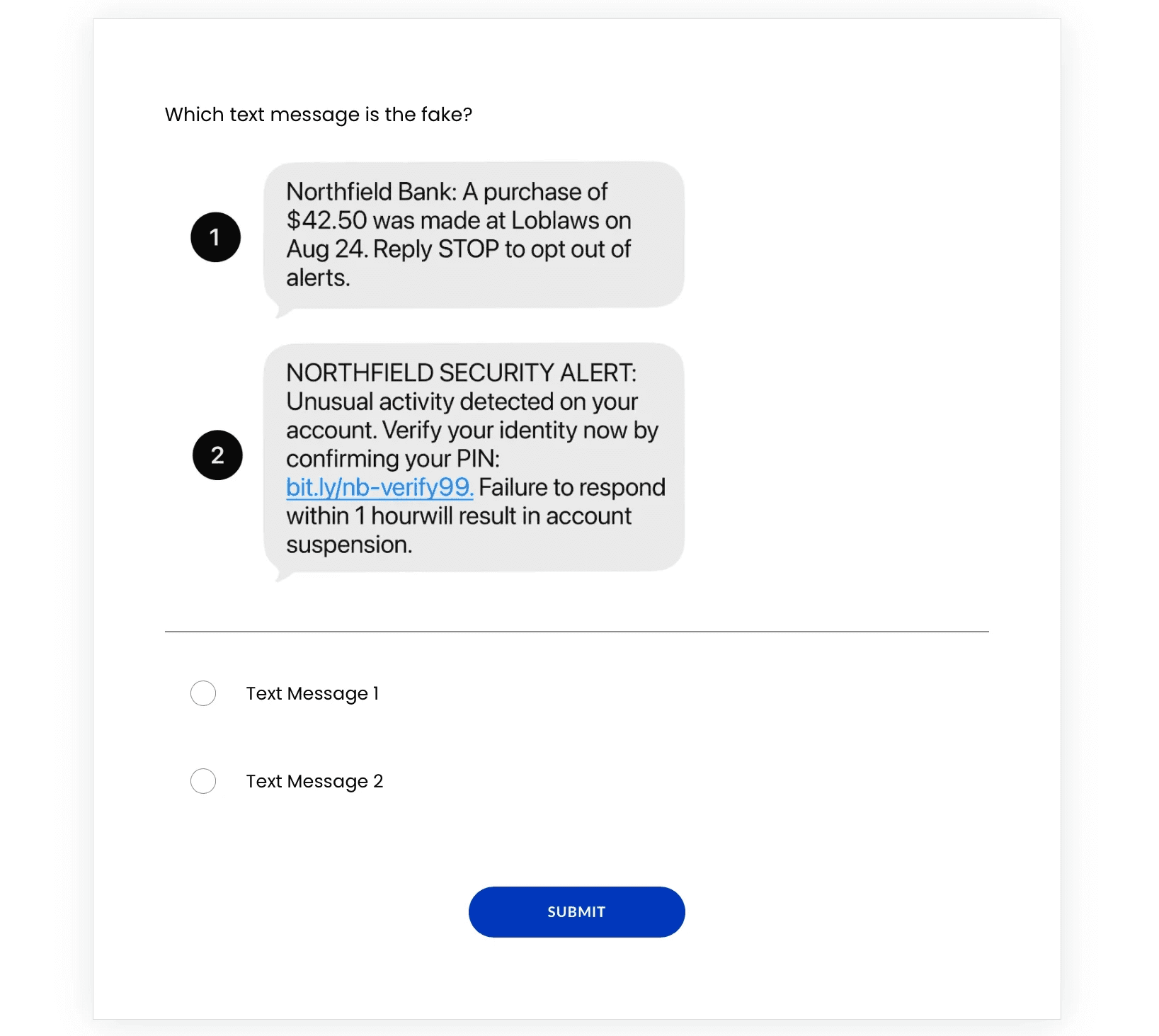
Contextual Scenarios: The summative assessments use branching logic to simulate everyday security challenges, such as identifying a malicious phishing text message layout.
This shifts evaluation away from rote text memorization toward active risk awareness and behavior modification.
Contextual Scenarios: The summative assessments use branching logic to simulate everyday security challenges, such as identifying a malicious phishing text message layout.
This shifts evaluation away from rote text memorization toward active risk awareness and behavior modification.
Contextual Scenarios: The summative assessments use branching logic to simulate everyday security challenges, such as identifying a malicious phishing text message layout.
This shifts evaluation away from rote text memorization toward active risk awareness and behavior modification.


Developing the illustrations from rough sketches to polished vectors in Adobe Illustrator:
Developing the illustrations from rough sketches to polished vectors in Adobe Illustrator:


EXPERIENCE THE COURSE
EXPERIENCE THE COURSE
EXPERIENCE THE COURSE


